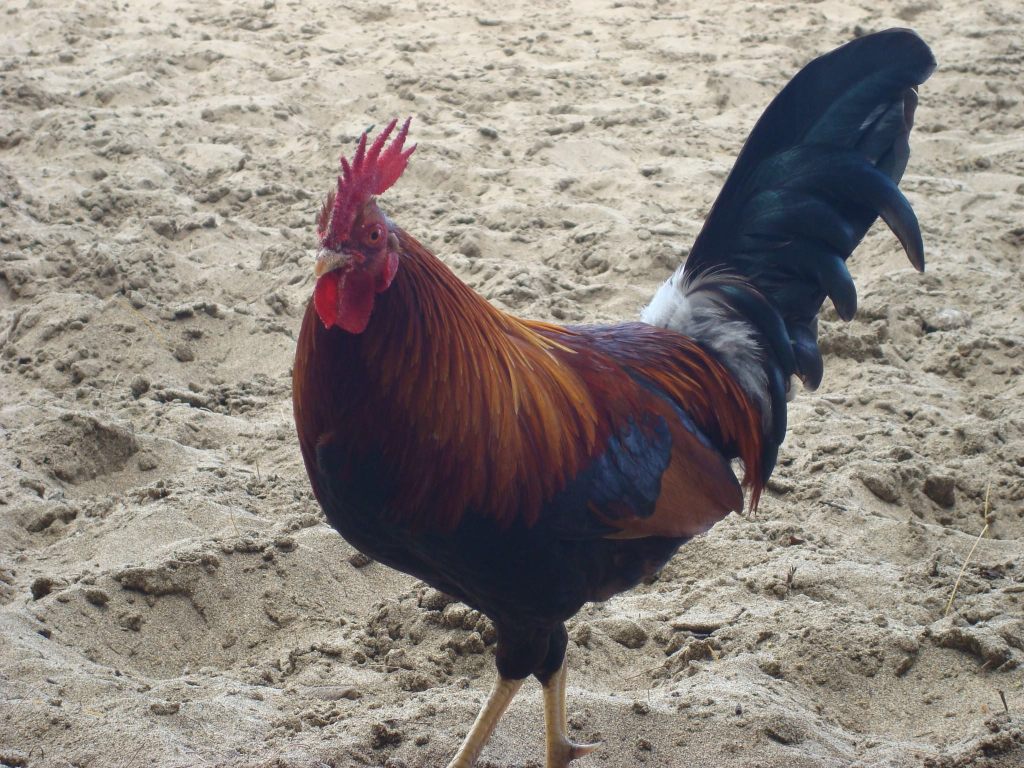
You’ll notice them before you even leave the airport parking lot.
A rooster, picking his way between rental cars with the confidence of someone who knows he owns the place. A hen hustling her chicks across the sidewalk outside baggage claim. Three more roosters crowing simultaneously from somewhere in the bushes, for no apparent reason, at 4:30 in the morning.
Welcome to Kauai. The chickens come with it.
If you’ve never visited before, nothing quite prepares you for the sheer density of wild chickens on this island. They’re everywhere — in parking lots, on beaches, outside restaurants, wandering through resort lobbies, strutting down hiking trails. Roosters crow all day and most of the night. Hens escort fuzzy chicks across busy roads with magnificent indifference to traffic. The chickens of Kauai do not care about you, your plans, or your rental car.
Here’s the story of how they got here — and what life with them is actually like.
How Did Kauai Get So Many Wild Chickens?
The answer involves both ancient history and one of the most destructive storms in Hawaiian history.
The ancient layer: Long before Hurricane Iniki, Polynesians who first settled the Hawaiian islands brought chickens with them as a food source. These were the moa — a hardy, semi-wild breed that could fend for itself and had been living freely on Kauai for centuries. Unlike the other Hawaiian islands, Kauai never developed a significant population of mongooses (the small predatory mammals introduced to other islands in the 1880s to control rats on sugar plantations). On Maui, Oahu, and the Big Island, mongooses prey on ground-nesting birds and their eggs — keeping feral chicken populations in check. On Kauai, the mongoose never took hold, and the moa had few natural predators.
The Hurricane Iniki layer: On September 11, 1992, Hurricane Iniki made direct landfall on Kauai — the most powerful hurricane to strike Hawaii in recorded history. With sustained winds of 145 mph, Iniki devastated the island, destroying thousands of homes and causing over $3 billion in damage. It also blew apart chicken coops across the island, releasing thousands of domestic chickens into an environment that already had a thriving wild population. The domestic chickens interbred with the feral moa, and with no natural predators to control them, the resulting hybrid population exploded.
By the time we started visiting in the early 2000s, the chickens were already a defining feature of the island. In the years since, their numbers have only grown.
What It’s Actually Like Living (and Vacationing) With the Chickens
Let’s be honest: the roosters are the main event. Hawaiian wild roosters are not like their domesticated cousins — they do not crow only at dawn. They crow at midnight. They crow at 3am. They crow at the first suggestion of light, which in Kauai in summer is around 5am. They crow in response to car alarms, other roosters, and apparently their own thoughts. If you’re staying somewhere with windows that open to the outside — which is most of Kauai’s rental properties, since the trade winds make air conditioning unnecessary — you will hear roosters.
Our advice: embrace it. After nearly 20 years of visits, the sound of roosters has become part of what “Kauai” means to us. It’s the sound of Kauai – and we included a recording of the ambient rooster sound here because it’s genuinely part of the experience. Bring earplugs if you’re a light sleeper, but know that most visitors adapt within a night or two.
The hens and chicks are, without exception, delightful. Watching a mother hen hustle eight tiny chicks across a beach parking lot is one of those small Kauai moments that sticks with you. The chicks are impossibly small and fluffy and remarkably fast. You’ll see them everywhere — outside restaurants, on hiking trails, in resort gardens.
A few practical notes from experience:
Don’t feed them. It encourages them to congregate in numbers and can create genuinely chaotic scenes outside restaurants and food trucks.
Watch where you step. Especially in grassy areas, parking lots, and trailheads. You know why.
They’re surprisingly fast. Don’t try to catch one.
The Cats: Kauai’s Other Feral Residents
In recent years, the wild chicken population on Kauai has noticeably decreased. The reason? Mostly it’s us, humans. But we suspect the cats have helped.
Cats were introduced to Kauai at some point — the exact origin is debated — and have established a significant feral population of their own. Unlike mongooses, which are active hunters, cats tend to prey on eggs and young chicks rather than adult birds. Over time, this predation has put meaningful pressure on the chicken population, particularly in areas where feral cats are well-established.
The result is that Kauai now has two thriving feral populations living in an uneasy ecological balance. You’ll see the cats too — often near the same places you see the chickens, lounging outside restaurants or appearing from the bushes at dusk. The cats are generally well-habituated to humans and not aggressive, but they’re wild animals and shouldn’t be fed or approached.
The ecological picture is more complicated than it might appear. Both feral chickens and feral cats pose challenges for Kauai’s native bird population — the cats in particular are a significant threat to ground-nesting Hawaiian seabirds. The island’s wildlife managers are navigating a difficult balance between the feral populations and the native species that need protection. It’s worth knowing about, even if the roosters outside your window are a more immediate concern.
Frequently Asked Questions: Kauai’s Wild Chickens
Why does Kauai have so many wild chickens?
Kauai’s wild chicken population is the result of two intersecting factors: the ancient moa — semi-wild chickens brought to Hawaii by Polynesian settlers — which have lived freely on the island for centuries, and Hurricane Iniki in 1992, which destroyed chicken coops across the island and released thousands of domestic birds into the wild. The two populations interbred, and with no natural predators (Kauai is the only major Hawaiian island without mongooses), their numbers grew dramatically.
Why do roosters crow all night in Kauai?
Hawaiian wild roosters — descended from ancient Polynesian moa — aren’t calibrated to crow only at dawn the way domesticated roosters are. They crow in response to light changes, other roosters, noise, and seemingly random impulse, at all hours of the day and night. It’s one of the most consistent surprises for first-time visitors. Earplugs are a legitimate packing recommendation if you’re a light sleeper. See our Kauai Packing List — we include them.
Are the wild chickens in Kauai dangerous?
No — the chickens are not aggressive toward humans and pose no safety risk. Roosters will occasionally posture or flare their feathers if you get too close, but actual attacks are extremely rare. The main practical concern is watching where you step. Don’t try to catch or corner them, don’t feed them, and you’ll coexist peacefully.
What is Hurricane Iniki?
Hurricane Iniki struck Kauai on September 11, 1992, and remains the most powerful hurricane ever to hit Hawaii. With sustained winds of 145 mph, it caused catastrophic damage across the island — destroying thousands of homes, damaging or destroying most of Kauai’s hotels and resorts, and causing over $3 billion in damage. Among its many consequences was the liberation of chickens from coops across the island, which contributed significantly to the feral chicken population you see today. Kauai recovered remarkably from Iniki, though the chickens remain as a permanent reminder.
Are there fewer chickens in Kauai now?
Yes — the population has noticeably declined in recent years, largely due to the establishment of a feral cat population that preys on eggs and young chicks. That said, there are still a lot of chickens. Don’t come expecting a chicken-free vacation.
Do other Hawaiian islands have wild chickens?
All the main Hawaiian islands have some feral chickens, but none come close to Kauai’s density. The key difference is the mongoose — introduced to Maui, Oahu, and the Big Island in the 1880s to control rats, mongooses also prey heavily on ground-nesting birds and keep feral chicken populations in check. Kauai’s mongoose-free status (the animals never successfully established themselves here) is the primary reason the chicken population is so dramatically higher than on other islands.
The chickens are one of those things about Kauai that sounds like an annoyance in the abstract and becomes part of what you love about the island in practice. By your third morning, waking up to roosters crowing over a cup of coffee on the lanai starts to feel like home. For more on what makes Kauai unique, see our Top 5 Reasons to Visit and our Island Orientation guide.


Leave a Reply