Kauai is the best hiking island in Hawaii. We’ll say it plainly. The Na Pali Coast, Waimea Canyon, Kokee above NaPali, the lush East Shore ridgelines — no other Hawaiian island concentrates this much extraordinary terrain in one place. After nearly 20 years of annual visits, we’ve hiked most of the trails on the island multiple times, in every season, in every condition from brilliant sunshine to driving rain. This is our definitive ranked guide.
A few things to know before you lace up:
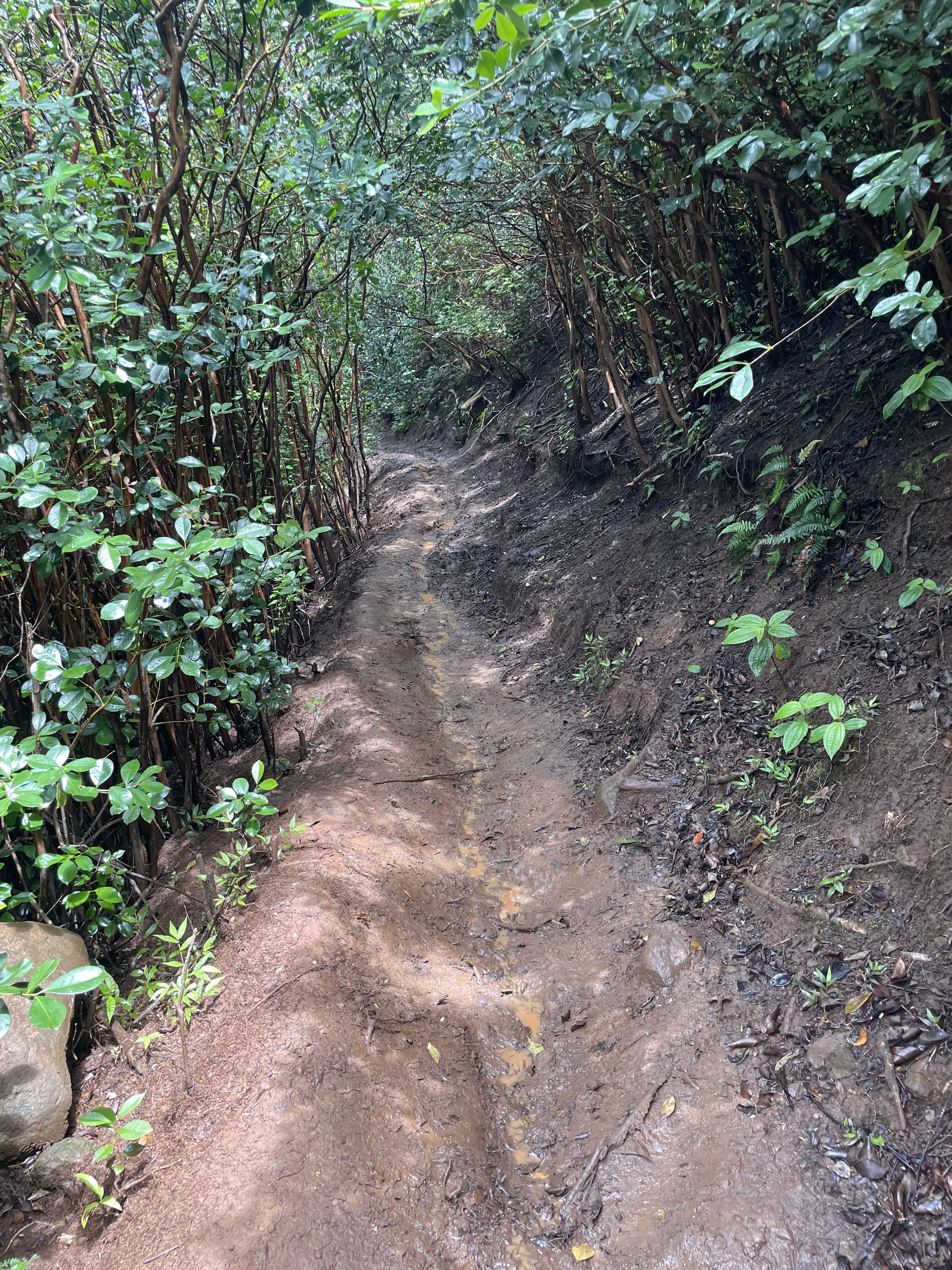
Expect mud. Kauai hiking means mud — even in summer, even on the “easier” trails. The red clay on Kauai’s trails is extraordinarily slippery when wet, which is most of the time. Standard trail runners are not adequate for most of these hikes. We strongly recommend approach shoes with sticky rubber soles — see our gear notes below.
Bring poles. Trekking poles are not optional on the steeper trails. The descent on muddy Kauai terrain without poles is miserable and dangerous. Collapsible poles pack easily and earn their luggage space.
Go early. Afternoon showers are common on windward trails. Trailhead parking fills up at popular spots. The light is better. Go early.
Quick Links
- Essential Gear for Kauai Hiking
- #1: Kalalau Trail to Hanakapi’ai Beach
- Bonus Hike to Hanakapi’ai Falls
- #2: Canyon Trail to Wai’poo Falls
- #3: Awa’awapuhi Trail
- #4: Okolehao Trail
- #5: Kuilau Ridge Trail (and the Moalepe Trail)
- #6: Mahaulepu Heritage Trail
- #7: Nounou Mountain (Sleeping Giant) East Trail
- #8: Pihea Vista Trail
- Hike Comparison at a Glance
- FAQ
Essential Gear for Kauai Hiking
Before the trails, the gear — because the wrong shoes on a Kauai hike are genuinely dangerous.
Shoes: We cannot overstate this. Kauai’s trails are muddier and slipperier than most mainland hikers expect. The red volcanic clay becomes like ice when wet, and steep sections are genuinely treacherous without the right footwear. Our consistent recommendation after years of trial and error: approach shoes with sticky rubber outsoles — the same technology used by rock climbers for scrambling. The La Sportiva TX4 (men’s) and TX2 (women’s) are our picks. The sticky rubber grips wet rock and mud dramatically better than standard hiking boot rubber. Yes, they’re an investment at $100–$150. Yes, they’re worth every dollar on Kauai.
Trekking poles: Essential for anything rated moderate or harder. The Black Diamond Trail Ergo Cork collapses to pack size and performs well on Kauai’s varied terrain. Don’t attempt the Okolehao, Awa’awapuhi, or Pihea trails without them.
Water: Bring more than you think you need. The combination of tropical heat, humidity, and elevation gain dehydrates you faster than most mainland trails. A 32oz Nalgene per person minimum; more for longer hikes.
Rain layer: Even on sunny days, windward trails can get surprise showers. A lightweight packable rain jacket takes up almost no space and is worth having.
Dry bag for your phone: The waterproof phone pouch we recommend in our packing guide is particularly useful on stream-crossing hikes like the Kalalau Trail and Hanakapi’ai Falls extension.
Spare shoes in the car: After a muddy hike, you don’t want to drive your rental car in caked red clay boots. Keep an old pair of shoes and a couple of towels in the trunk.

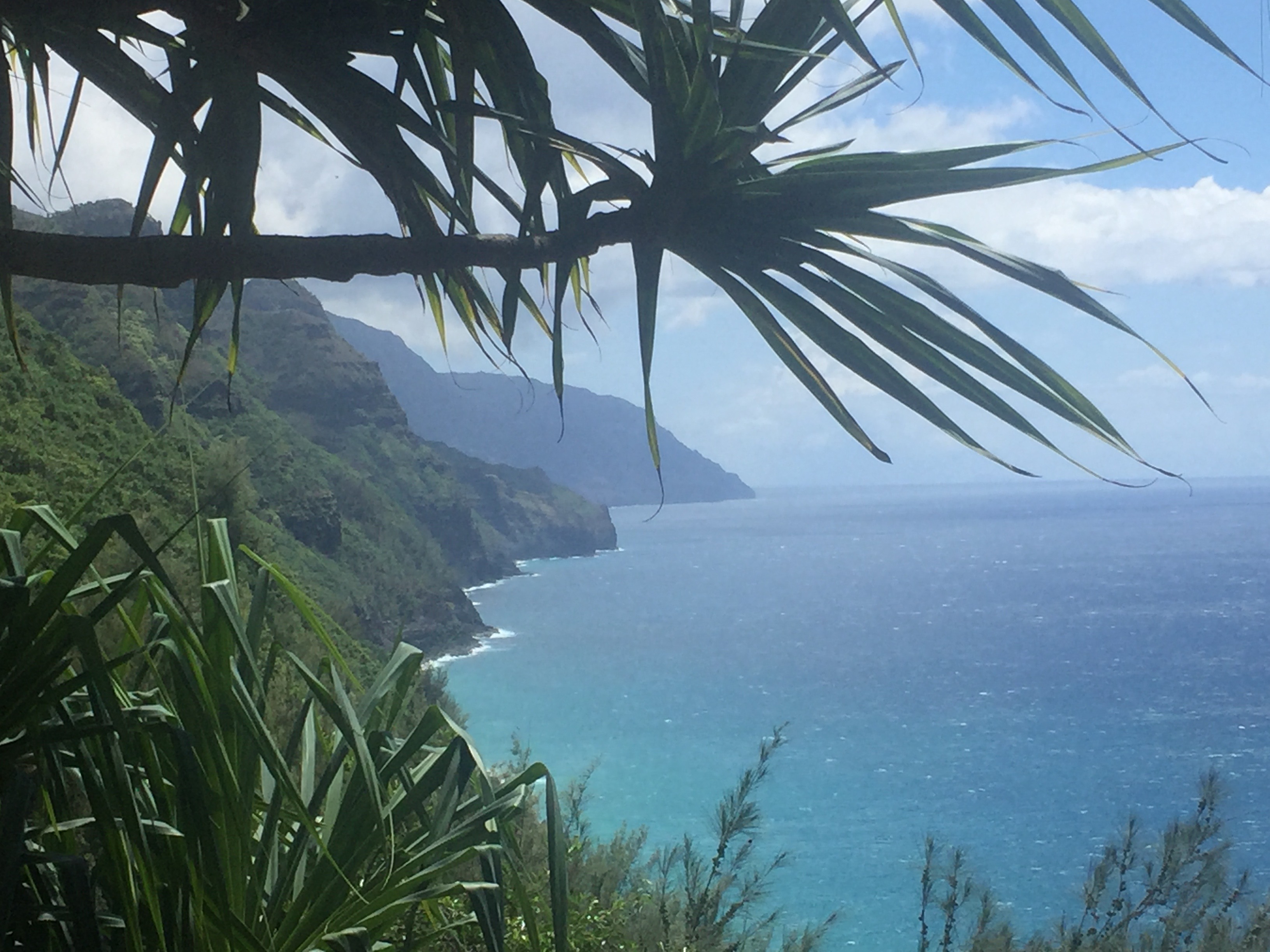
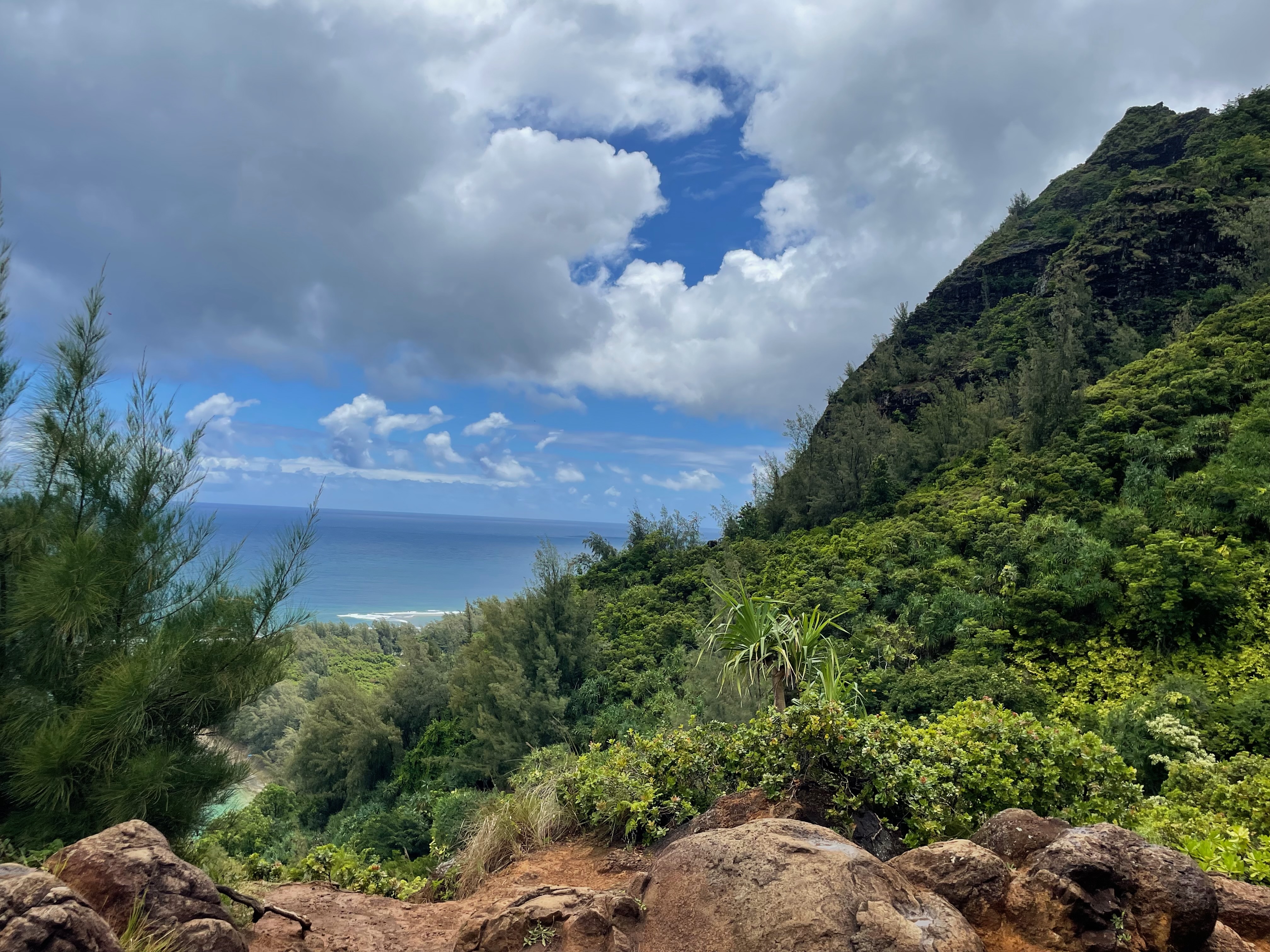
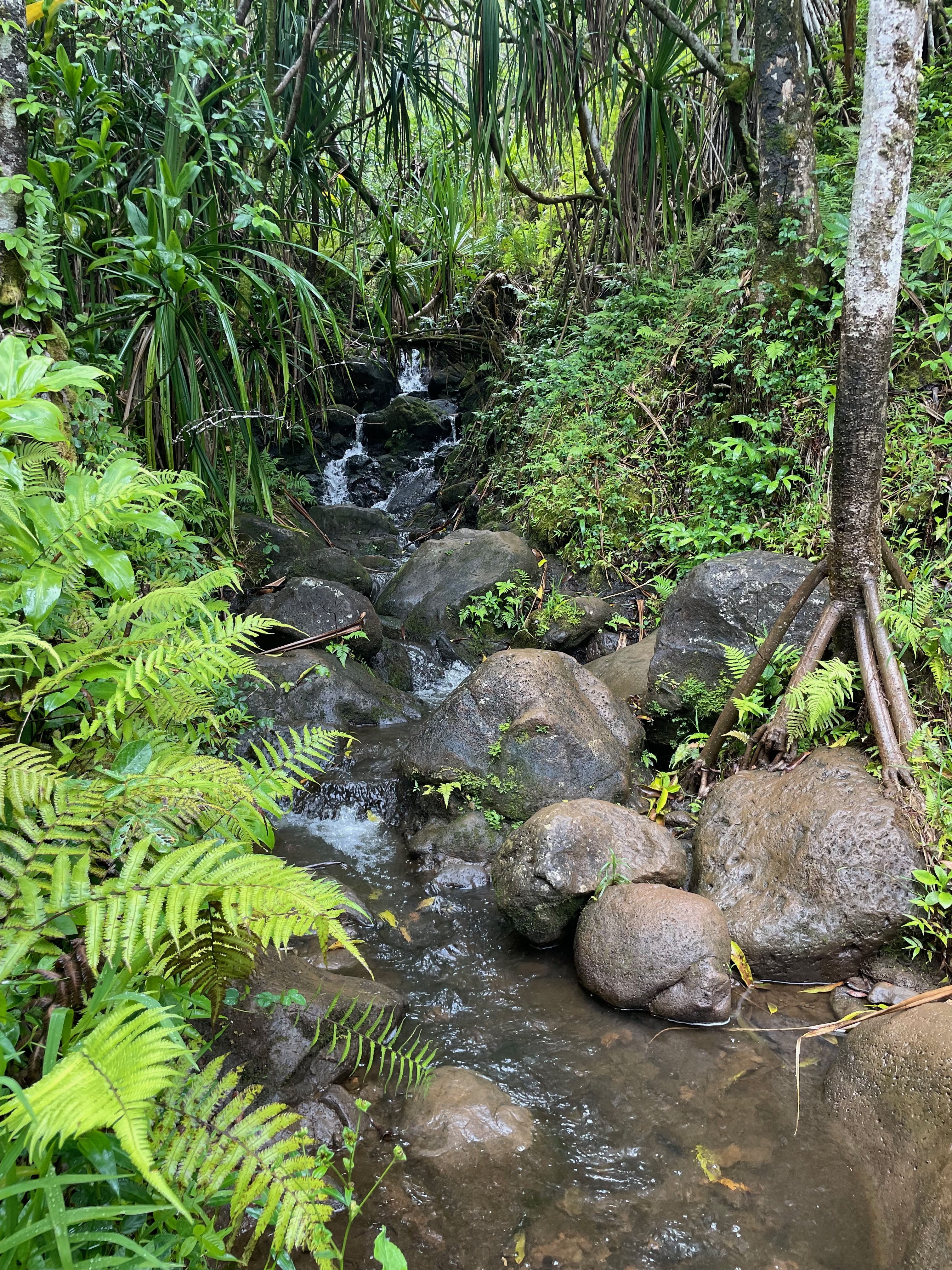
Distance: 4 miles roundtrip (to Hanakapi’ai Beach) Elevation Gain: 1,150 feet Difficulty: Moderate to Hard Shore: North Shore Permit required: Yes — parking permit ($25/vehicle, book 30 days in advance) or shuttle ($40/person) AllTrails: Hanakapi’ai Beach via the Kalalau Trail
This is the best hike on the island. We’ve said it in our one-week itinerary and we’ll say it again here: if you do one thing on Kauai, make it the Kalalau Trail to Hanakapi’ai Beach.
The trail begins at Ke’e Beach at the end of the North Shore road and follows the Na Pali cliffs for two miles to Hanakapi’ai Beach — a stunning, remote beach accessible only by foot. The views begin almost immediately: the trail climbs out of the parking area and within minutes you’re looking back over Ke’e Beach with the full sweep of Kauai’s northern coast behind you. From there, the trail alternates between jungle canopy and open cliff-edge with views of the Na Pali sea stacks and the Pacific hundreds of feet below.
The terrain is challenging — rocky, rooted, and slippery when wet, which is often. The 1,150 feet of elevation gain is spread across significant ups and downs rather than a steady climb, which means your legs are working the entire time. Bring poles. Wear approach shoes. Go early.
The logistics: The trailhead at Ke’e Beach requires a parking reservation through gohaena.com — book exactly 30 days in advance at $25/vehicle. These slots go fast; set a calendar reminder and book the moment the window opens. If you miss the parking reservation, shuttle tickets are available closer to your date for $40/person, but this is less flexible. See our vacation hacks guide for the full permit strategy.
The full trail: The complete Kalalau Trail runs 11 miles to Kalalau Beach — one of the greatest hikes in the world and on many serious hikers’ bucket lists. The full trail requires a camping permit and at least one or two nights on the trail. It’s extraordinary and genuinely demanding. Check ehawaii.gov for permits.
Our honest take: The 4-mile roundtrip to Hanakapi’ai Beach is the right call for most visitors — challenging enough to feel like an accomplishment, spectacular enough to justify the logistics, and achievable in a half day. We’ve done it more times than we can count and it never gets old.

Bonus Hike to Hanakapi’ai Falls
Distance: 8 miles roundtrip total (from trailhead) Additional gain from beach: ~1,200 feet Difficulty: Hard AllTrails: Hanakapi’ai Falls Trail
If you have the legs and the daylight for it, the extension from Hanakapi’ai Beach up to Hanakapi’ai Falls is one of the most rewarding full-day hikes on the island. From the beach, you follow the stream inland through dense jungle, crossing it multiple times, climbing steadily to a spectacular 300-foot waterfall at the trail’s end.
The stream crossings are the main logistical challenge — there are several, and they can be knee-deep or higher after rain. Check conditions before committing to this extension; flash flooding is possible and the stream can rise quickly. Waterproof shoes and poles are essential here. The falls themselves are extraordinary — a sheer drop into a pool surrounded by jungle — and well worth the effort on the right day.
Plan your day: Start at the trailhead no later than 7am if you’re doing the full roundtrip to the falls. Bring lunch and enough water for a full day on the trail.
#2: Canyon Trail to Wai’poo Falls
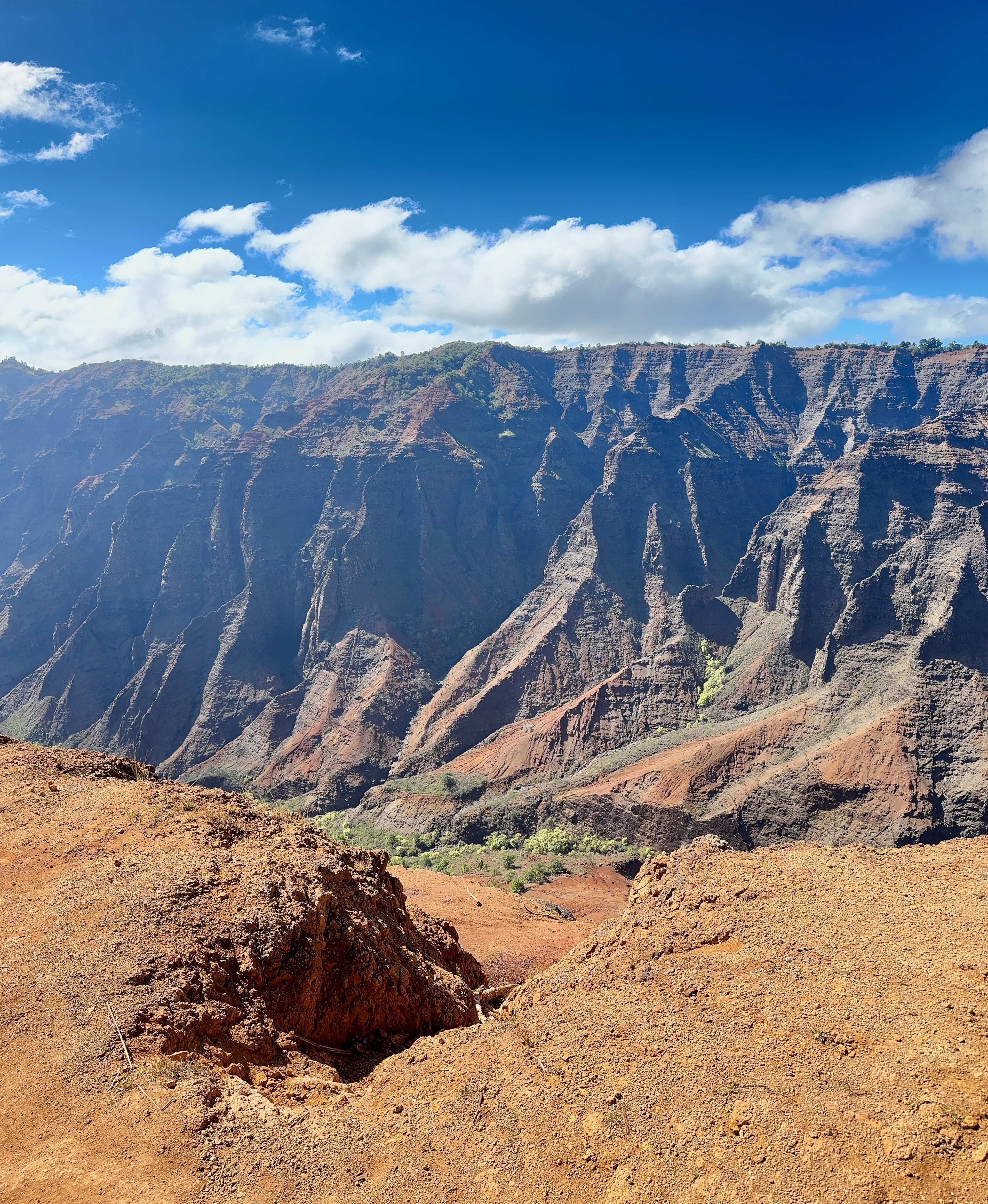

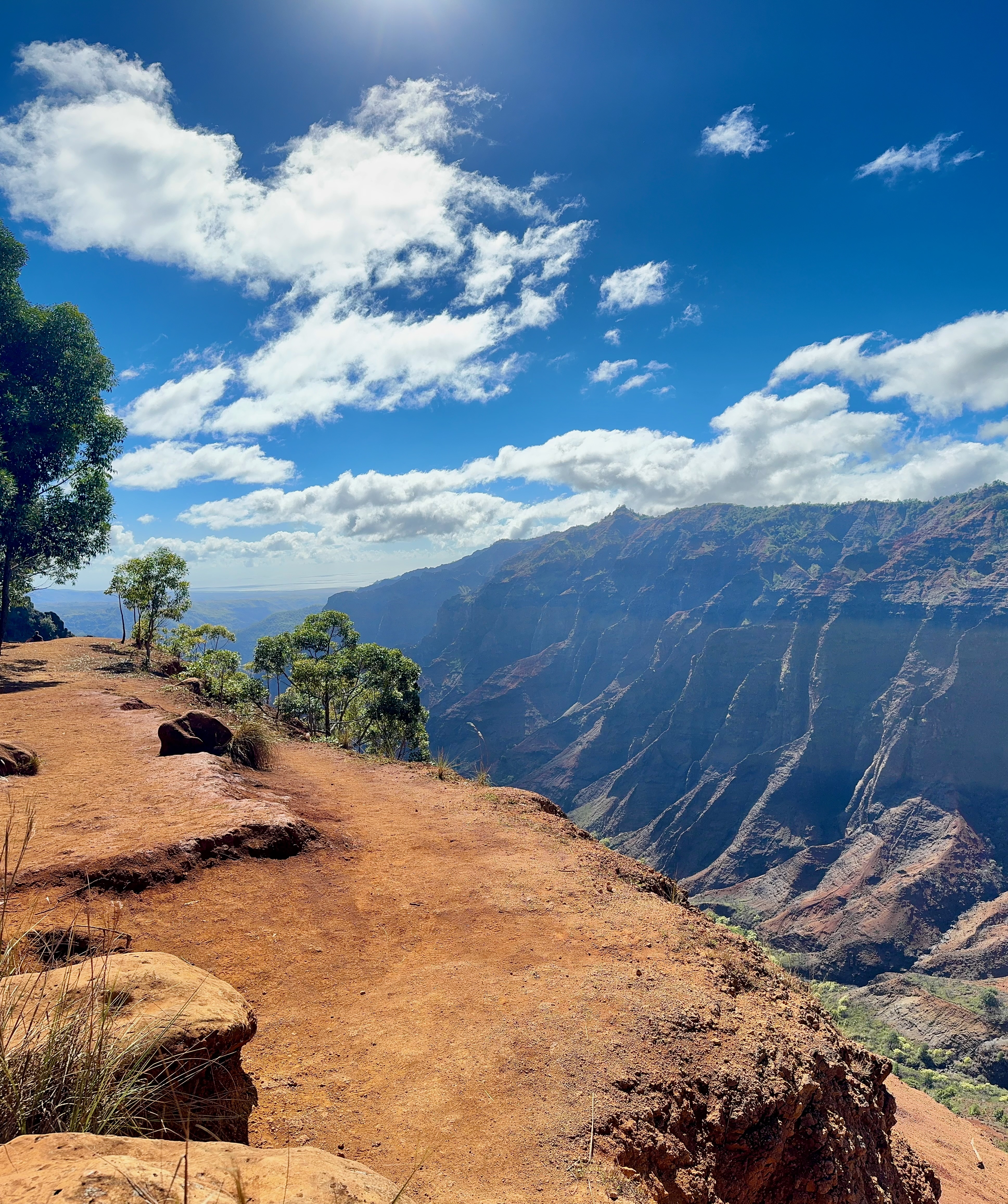
Distance: 3 miles roundtrip Elevation Gain: 1,237 feet Difficulty: Moderate to Hard Shore: West Shore (Waimea Canyon) Permit required: $10/vehicle park entrance fee AllTrails: Canyon Trail to Waipo’o Falls
Our favorite hike in Waimea Canyon, and one of the best on the island. While the canyon road overlooks give you spectacular views from a distance, the Canyon Trail puts you inside the canyon — on the rim, with the full depth of the gorge visible below you and the red and orange canyon walls close enough to touch.
The approach is slightly counterintuitive: park along the road just past the Canyon Lookout and follow a wide, rocky road about ¾ of a mile downhill, losing several hundred feet of elevation, before connecting to the narrower trail. This feels wrong when you’re doing it — you’re hiking down before you go up — but it’s well-signed and straightforward. Once on the canyon rim trail, the views open dramatically. The path follows the rim to the upper Wai’poo Falls and a small lagoon where you can swim — a genuinely refreshing reward after the climb.
A few honest notes: The trail is steep in sections and rocky throughout. The red dirt becomes extremely slippery when wet, which is most afternoons. Plan to go early — both for better weather and better light for canyon views. You cannot see the main Wai’poo Falls from the rim trail; you’re looking down from the top rather than up from below. The upper falls and lagoon are the payoff.
Combine with: A full Waimea Canyon and Kokee State Park day — see the canyon overlooks, hike the Canyon Trail, and continue up to Kokee State Park for the Kalalau Valley lookout. Our one-week itinerary lays out exactly how to structure this day.
#3: Awa’awapuhi Trail
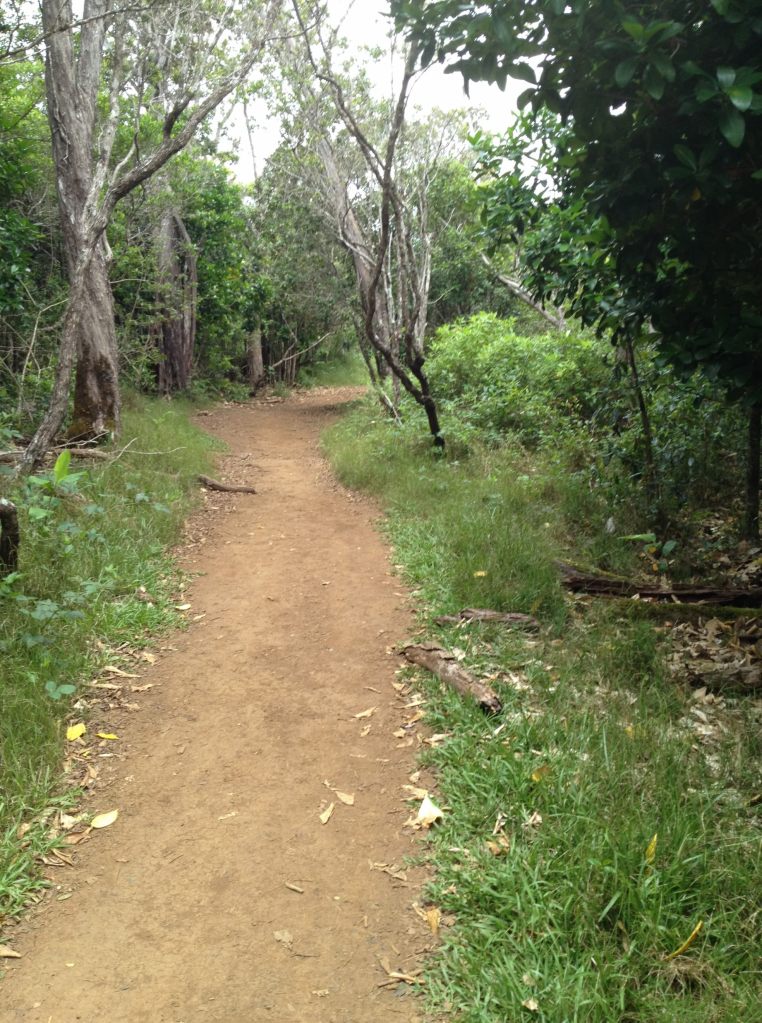
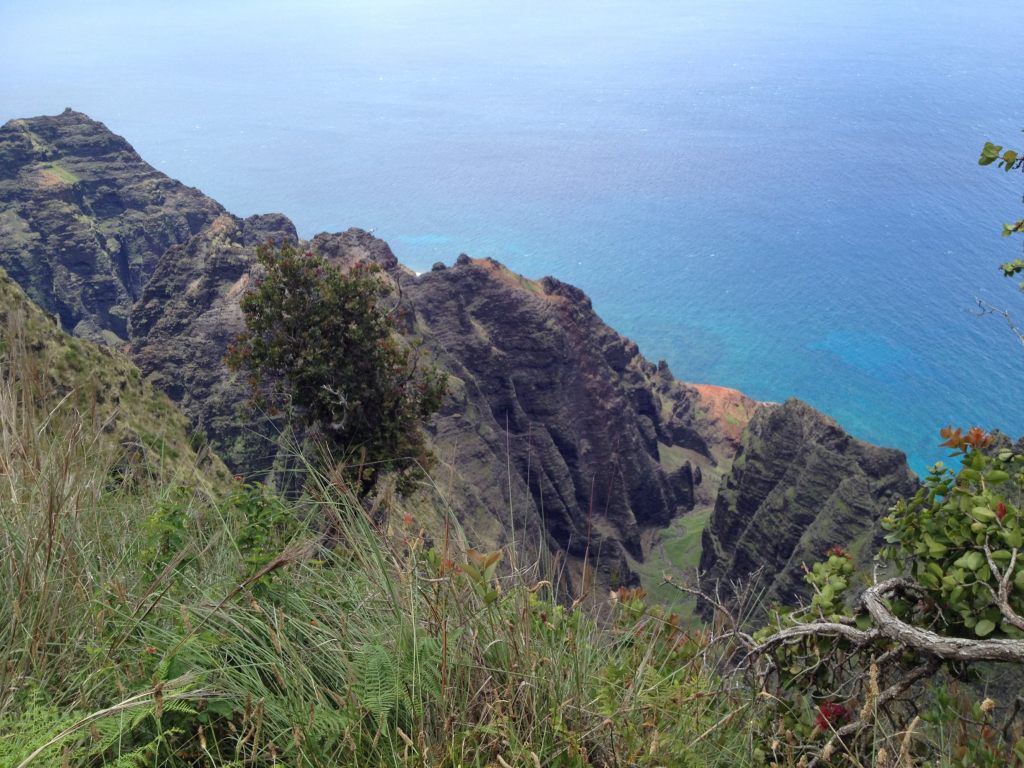

Distance: 6 miles roundtrip Elevation Gain: 1,900 feet Difficulty: Hard Shore: West Shore (Kokee State Park) Permit required: $10/vehicle park entrance fee AllTrails: Awa’awapuhi Trail
The Awa’awapuhi Trail is the most underrated hike on the island — less famous than the Kalalau Trail but arguably offering the most dramatic single viewpoint of the Na Pali Coast accessible by foot.
The trail begins in Kokee State Park and descends steadily through native forest for three miles to an exposed ridge overlooking the Awa’awapuhi and Nu’alolo valleys on the Na Pali coast. You’re mostly in the trees on the way down, with occasional glimpses of the cliffs on either side, which makes the finale all the more striking: the trail ends at an overlook where you’re standing 2,500 feet above the valley floor, with the full drama of the Na Pali cliffs and the Pacific spreading out below you. Photos genuinely don’t capture this view. It’s one of the most vertiginous, awe-inspiring perspectives we’ve experienced anywhere on earth.
The catch: What goes down must come up. After you’ve stood at that viewpoint and absorbed it, you have to turn around and climb 1,900 feet back through three miles of trail to the parking lot. It’s a legitimate physical effort. Go well-hydrated, start early, and give yourself a full morning.
Trailhead: The Awa’awapuhi trailhead is located along the Kokee Road in Kokee State Park, about 3.4 miles past the Kokee Museum. There is a small parking area at the trailhead.
#4: Okolehao Trail
Distance: 2.6 miles roundtrip to first lookout; 3.5 miles to second lookout Elevation Gain: 1,000+ feet Difficulty: Hard Shore: North Shore (Hanalei) Permit required: None AllTrails: Okolehao Viewpoint via Okolehao Trail
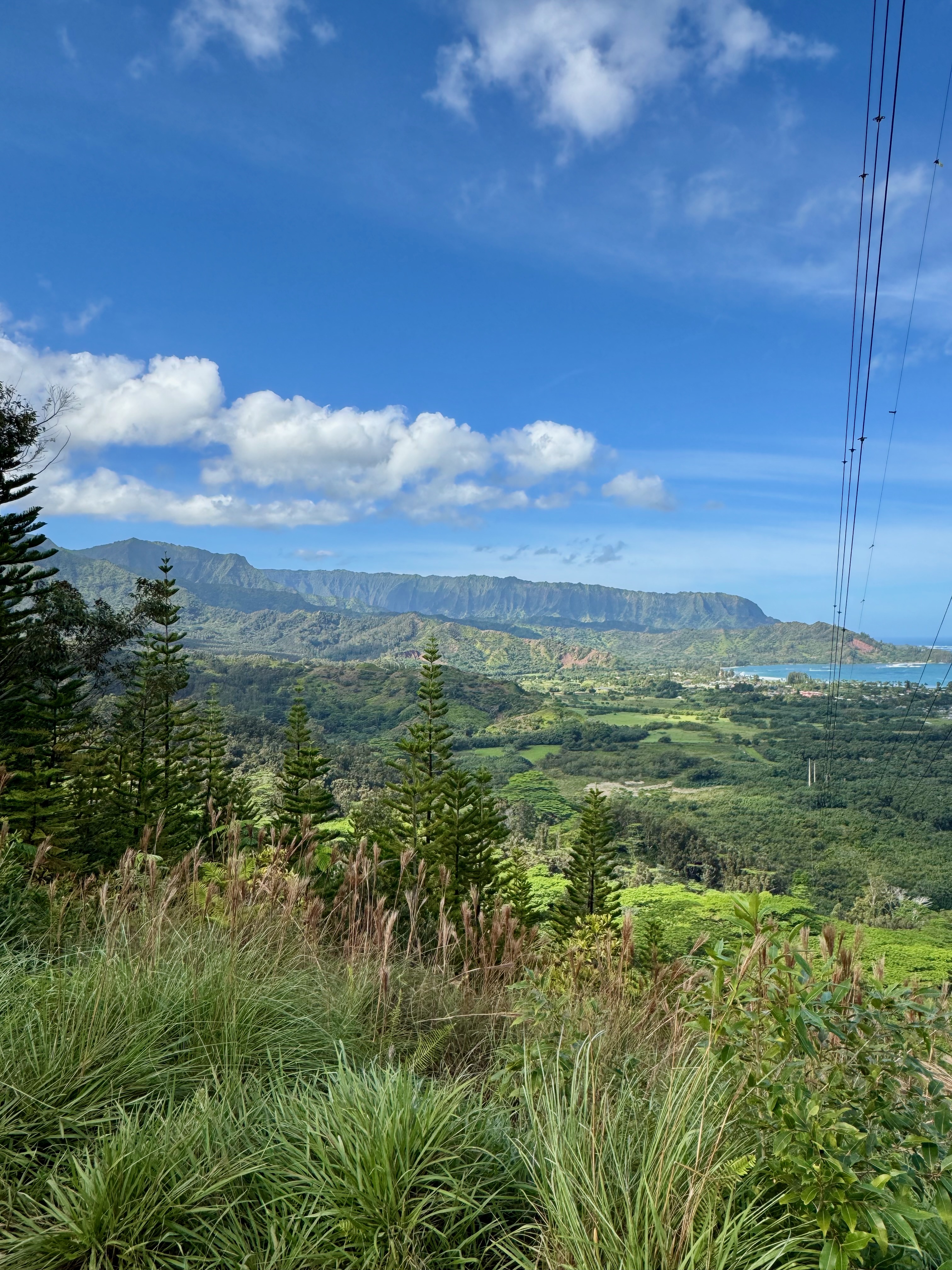
The Okolehao Trail sits just outside Hanalei and is one of the best ways to get an elevated perspective of the North Shore — the kind of view that shows you how dramatic the geography of this coastline really is.
The trail climbs steeply from the trailhead near the Hanalei River and gains elevation quickly — uncomfortably quickly in sections. It’s very muddy at the base, and the mud doesn’t really relent. This is a trail that demands good footwear.
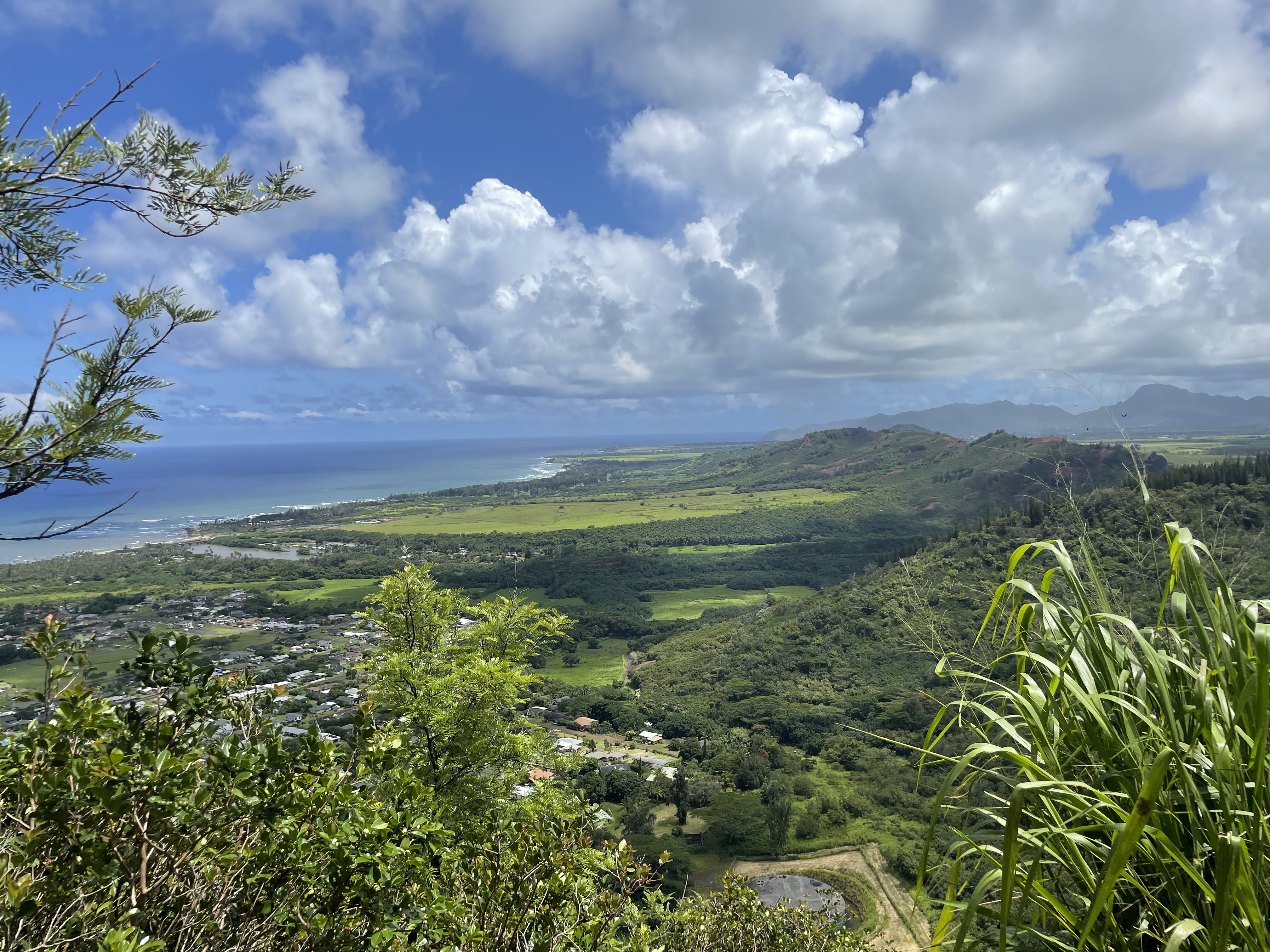
The first lookout, at a powerline pole about halfway up, is the right stopping point for most hikers. On a clear day, you can see Mt. Wai’ale’ale rising behind you and much of the North Shore coastline in front of you — Hanalei Bay, the river mouth, the mountains beyond. It’s genuinely beautiful and earns the effort to reach it.
If you want to continue to the second lookout, you’ll climb significantly more and eventually scramble up a rope-assisted cliff section to a viewpoint from which you can see nearly a third of the island. We’ve done this in the rain — including the rope descent on the way back, which is as wild as it sounds. We had poles and they were critical. Without them, we would have slid the entire way down.
Our honest take: The first lookout is enough for most people and delivers excellent views with slightly less drama. The second lookout is for experienced hikers who are comfortable with exposure and rope-assisted scrambling on wet rock. Either way: bring poles, wear approach shoes, and have dry shoes and towels in the car.

#5: Kuilau Ridge Trail (and the Moalepe Trail)
Distance: 3.5 miles roundtrip to the junction; 5+ miles if you continue on the Moalepe Trail Elevation Gain: 680 feet (to junction); 1,000+ feet for the full route Difficulty: Easier side of Moderate Shore: East Shore (near Kapa’a) Permit required: None AllTrails: Kuilau Ridge Trail / Moalepe Trail
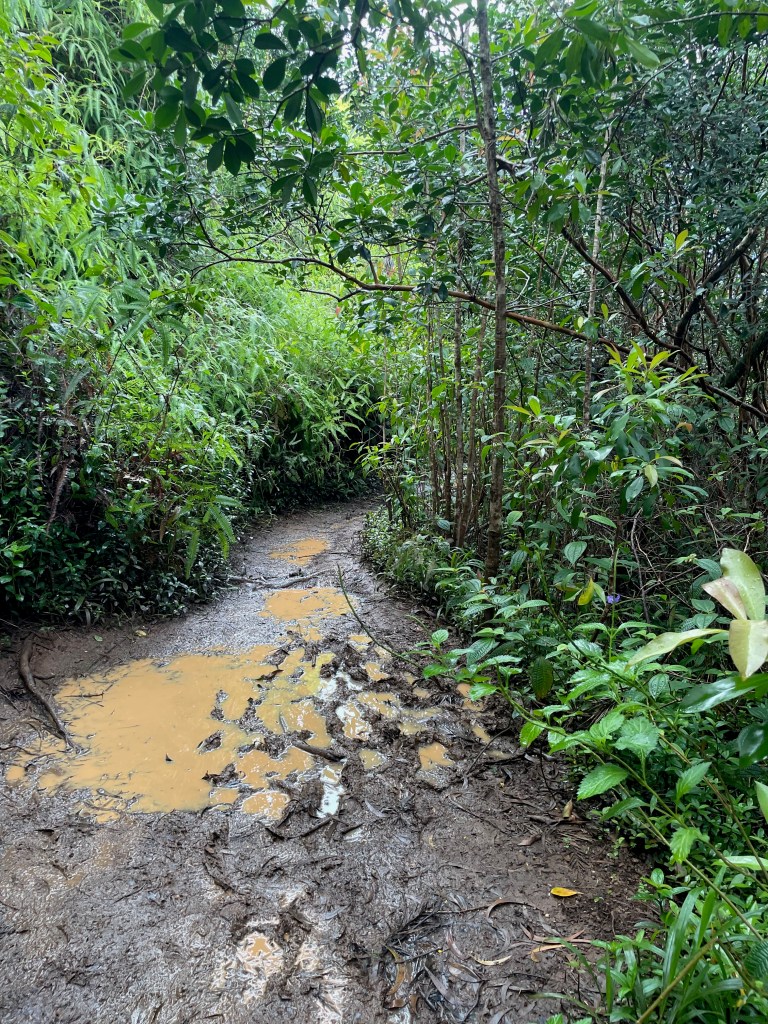
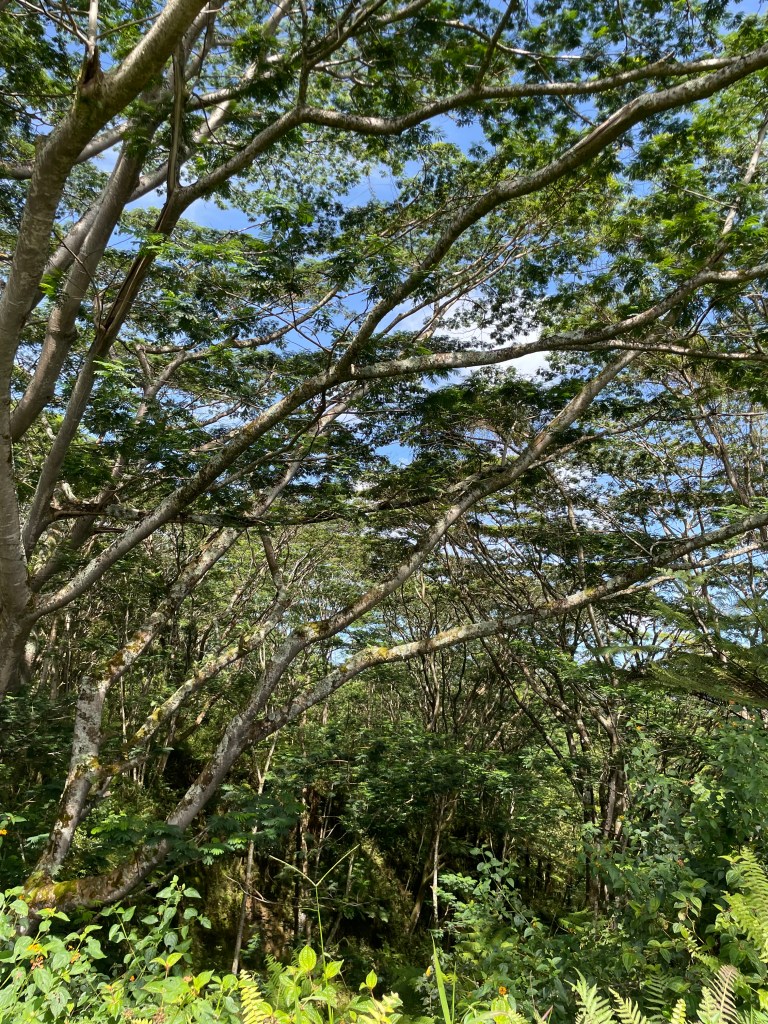
The Kuilau Ridge Trail is our top recommendation for families with younger children or hikers who want a beautiful Kauai trail without the full physical commitment of the Kalalau or Canyon trails. It’s one of the better-shaded trails on the island — a significant virtue on a hot day — and while it’s not mud-free by Kauai standards, it’s among the least muddy of the major trails.
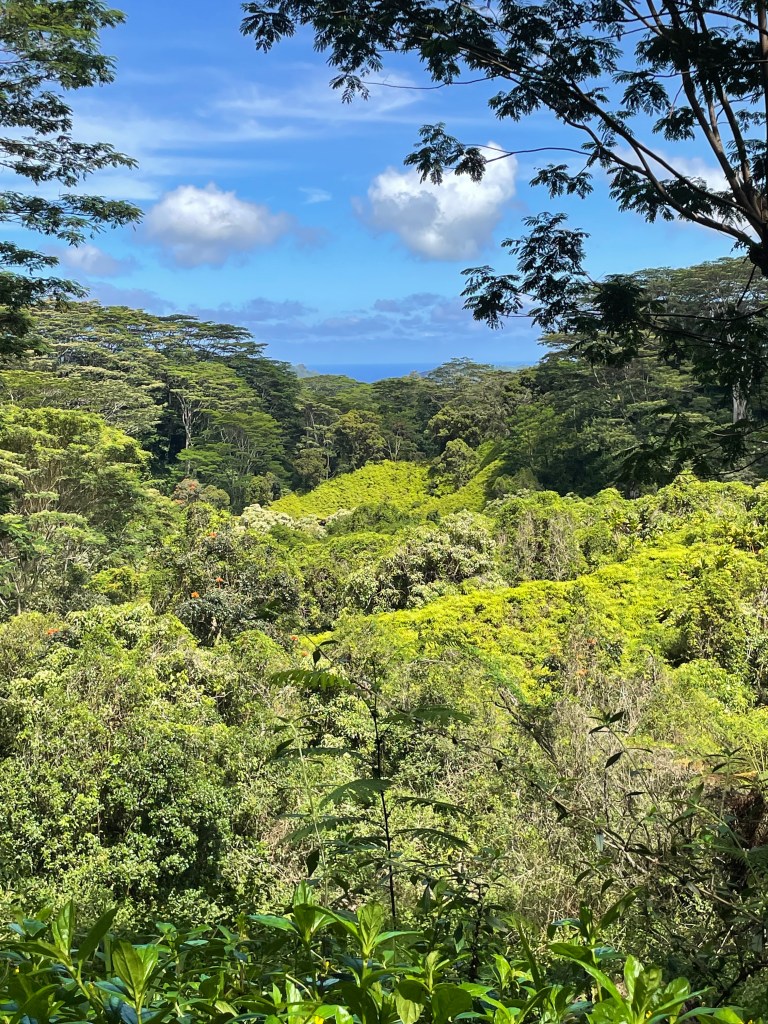
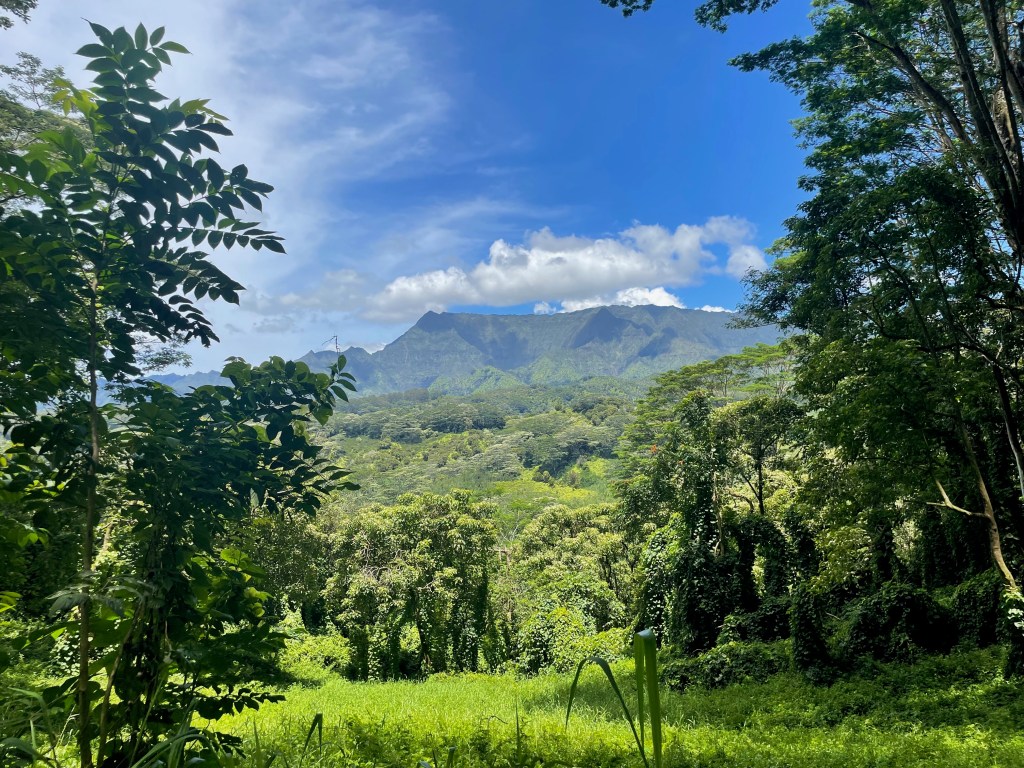
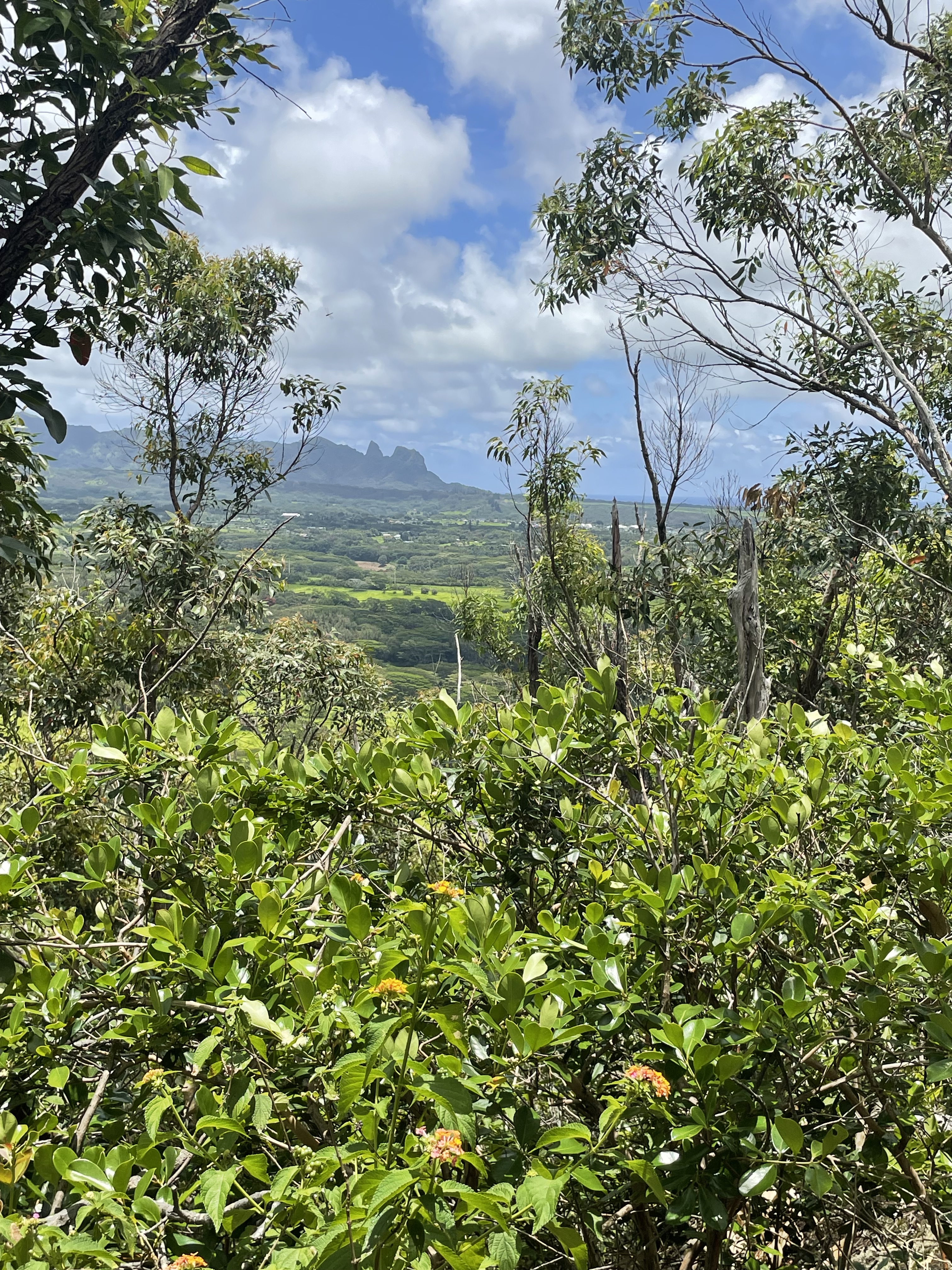
The trailhead is located several miles past ‘Opaeka’a Falls along Route 580, with plenty of parking. The trail climbs steadily along the ridge with consistently improving views of Mt. Wai’ale’ale — the ancient, cloud-capped volcano at the island’s center — and the broader East Shore landscape. Hike at least the first mile and a half to the picnic table on the ridge: the views from here are excellent and well worth the effort.
If you continue past the picnic table, the trail descends into a section of genuine tropical jungle — the kind of dense, wet, movie-set greenery that makes you understand why Kauai has been used as a film location for Jurassic Park, Raiders of the Lost Ark, and dozens of other productions. The trail eventually connects to the Moalepe Trail, which descends back toward Kapa’a — making a full loop possible if you arrange a car shuttle at the Moalepe trailhead.
Combine with: This trail is a natural add-on to a Wailua River kayaking day. Paddle to Secret Falls in the morning, return your kayaks by early afternoon, then drive up to the Kuilau trailhead for a few hours of hiking before dinner in Kapa’a.
#6: Mahaulepu Heritage Trail
Distance: 3.8 miles roundtrip Elevation Gain: 400 feet Difficulty: Easy Shore: South Shore (near Poi’pu) Permit required: None AllTrails: Maha’ulepu Heritage Trail
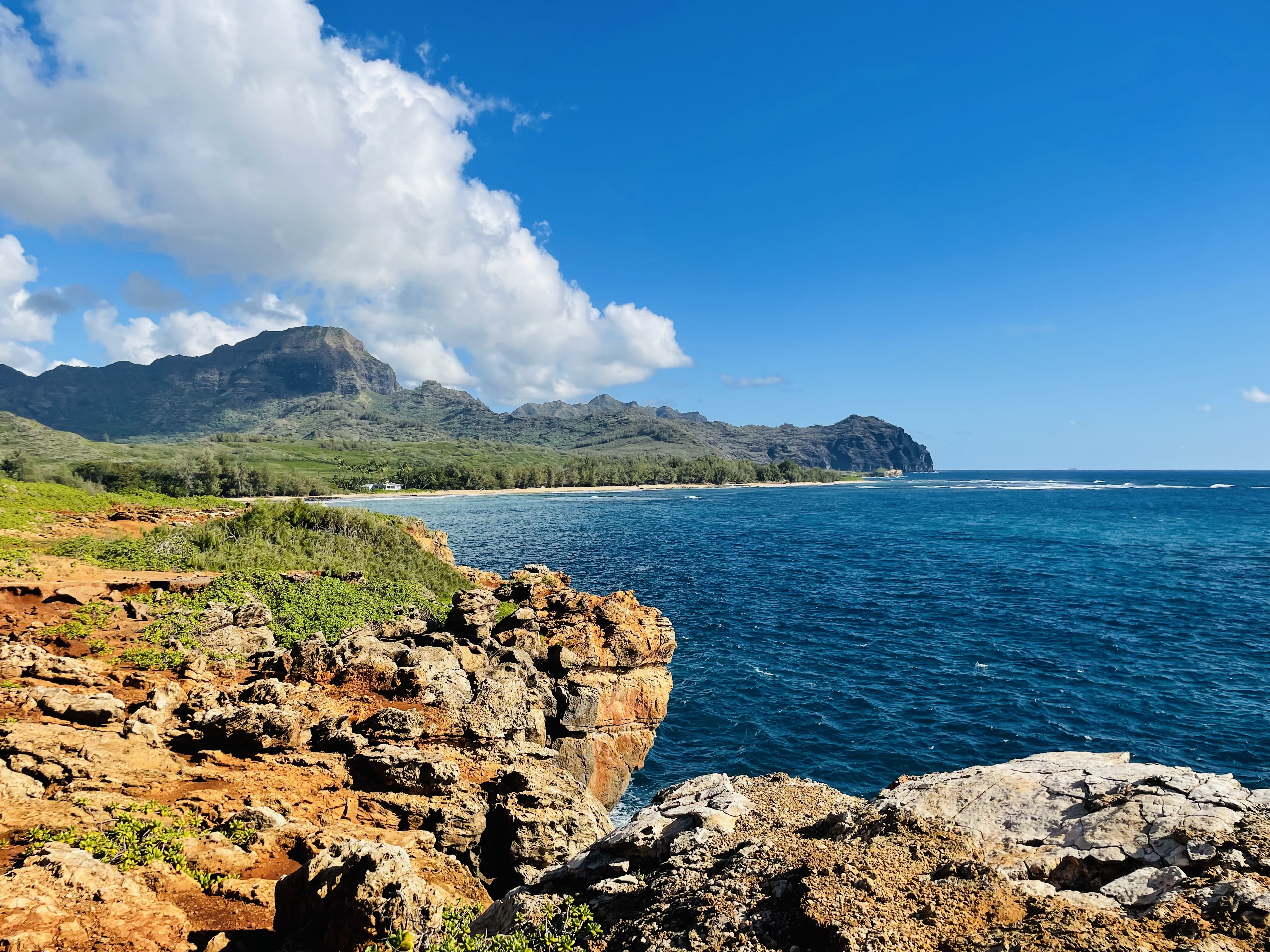
Kauai’s best easy hike — and the only trail on this list where you don’t need to worry much about mud. The Mahaulepu Heritage Trail follows the dramatic South Shore coastline from Shipwreck Beach to Punahoa Point, tracing ancient sea cliffs with views that stretch both directions along the coast.
This is not a jungle trail. It’s an open coastal walk with constant ocean views, interesting geological formations (the ancient sand dunes turned to limestone are fascinating), and excellent wildlife watching. We’ve spotted sea turtles resting in the rocky coves below the trail, a manta ray gliding through a shallow bay, monk seals hauled out on the rocks, and — in winter — humpback whales breaching offshore. The trail is also culturally significant; interpretive signs along the route explain the area’s importance to Native Hawaiian history.
Best for: Families, less experienced hikers, anyone staying on the South Shore who wants a beautiful walk that doesn’t require approach shoes and trekking poles. Also excellent for a sunrise or early morning walk — the light on the coastline in the first hour of the day is extraordinary.
Parking: At Shipwreck Beach, near the Grand Hyatt Kauai. The beach is public and parking is available, though it can fill on busy afternoons.

Distance: 3.8 miles roundtrip Elevation Gain: 400 feet Difficulty: Easy Shore: South Shore (near Poi’pu) Permit required: None AllTrails: Maha’ulepu Heritage Trail
Kauai’s best easy hike — and the only trail on this list where you don’t need to worry much about mud. The Mahaulepu Heritage Trail follows the dramatic South Shore coastline from Shipwreck Beach to Punahoa Point, tracing ancient sea cliffs with views that stretch both directions along the coast.
This is not a jungle trail. It’s an open coastal walk with constant ocean views, interesting geological formations (the ancient sand dunes turned to limestone are fascinating), and excellent wildlife watching. We’ve spotted sea turtles resting in the rocky coves below the trail, a manta ray gliding through a shallow bay, monk seals hauled out on the rocks, and — in winter — humpback whales breaching offshore. The trail is also culturally significant; interpretive signs along the route explain the area’s importance to Native Hawaiian history.
Best for: Families, less experienced hikers, anyone staying on the South Shore who wants a beautiful walk that doesn’t require approach shoes and trekking poles. Also excellent for a sunrise or early morning walk — the light on the coastline in the first hour of the day is extraordinary.
Parking: At Shipwreck Beach, near the Grand Hyatt Kauai. The beach is public and parking is available, though it can fill on busy afternoons.
#8: Pihea Vista Trail
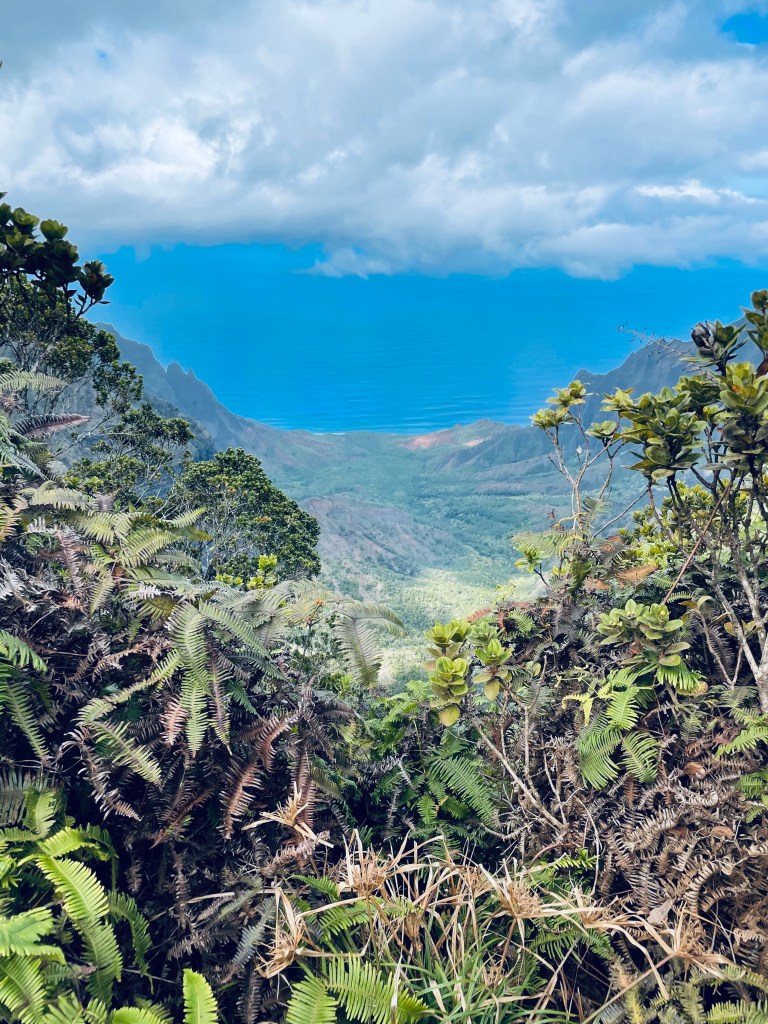
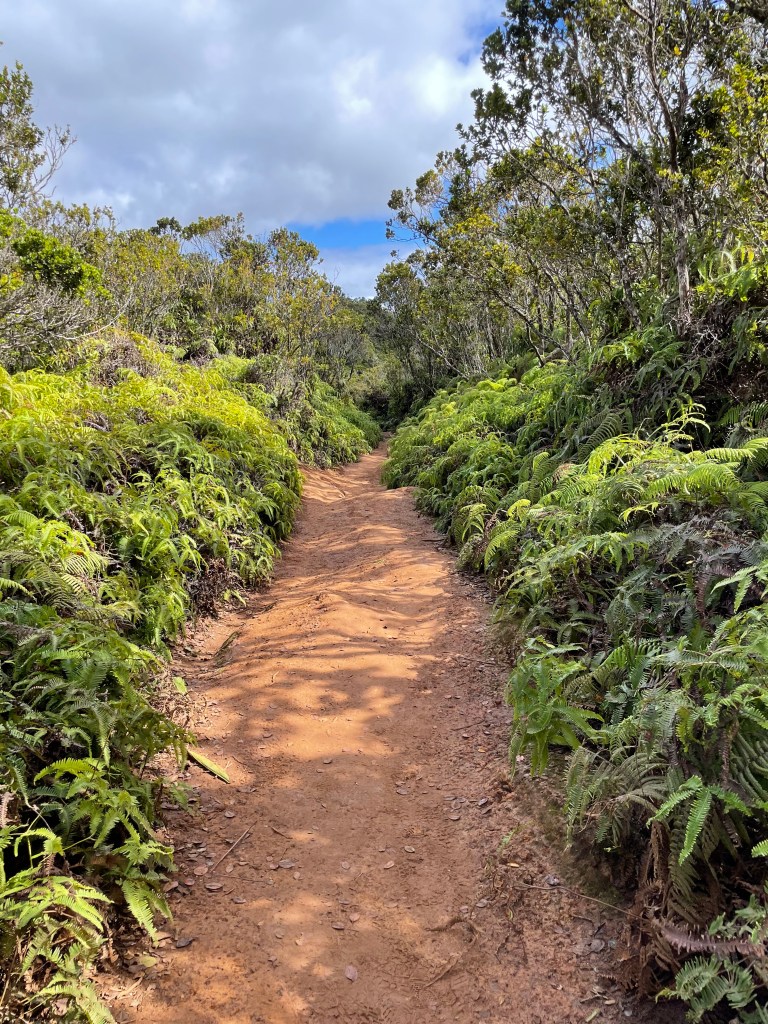
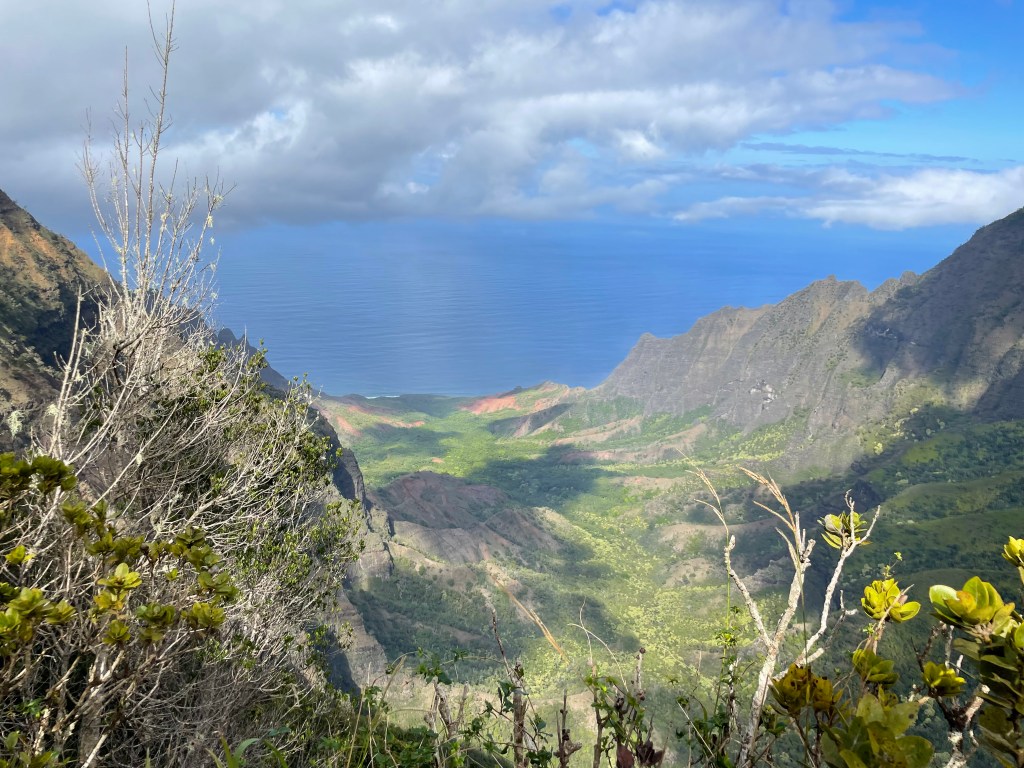
Distance: 4.4 miles roundtrip Elevation Gain: 715 feet Difficulty: Moderate Shore: West Shore (Kokee State Park) Permit required: $10/vehicle park entrance fee AllTrails: Pihea Vista Trail
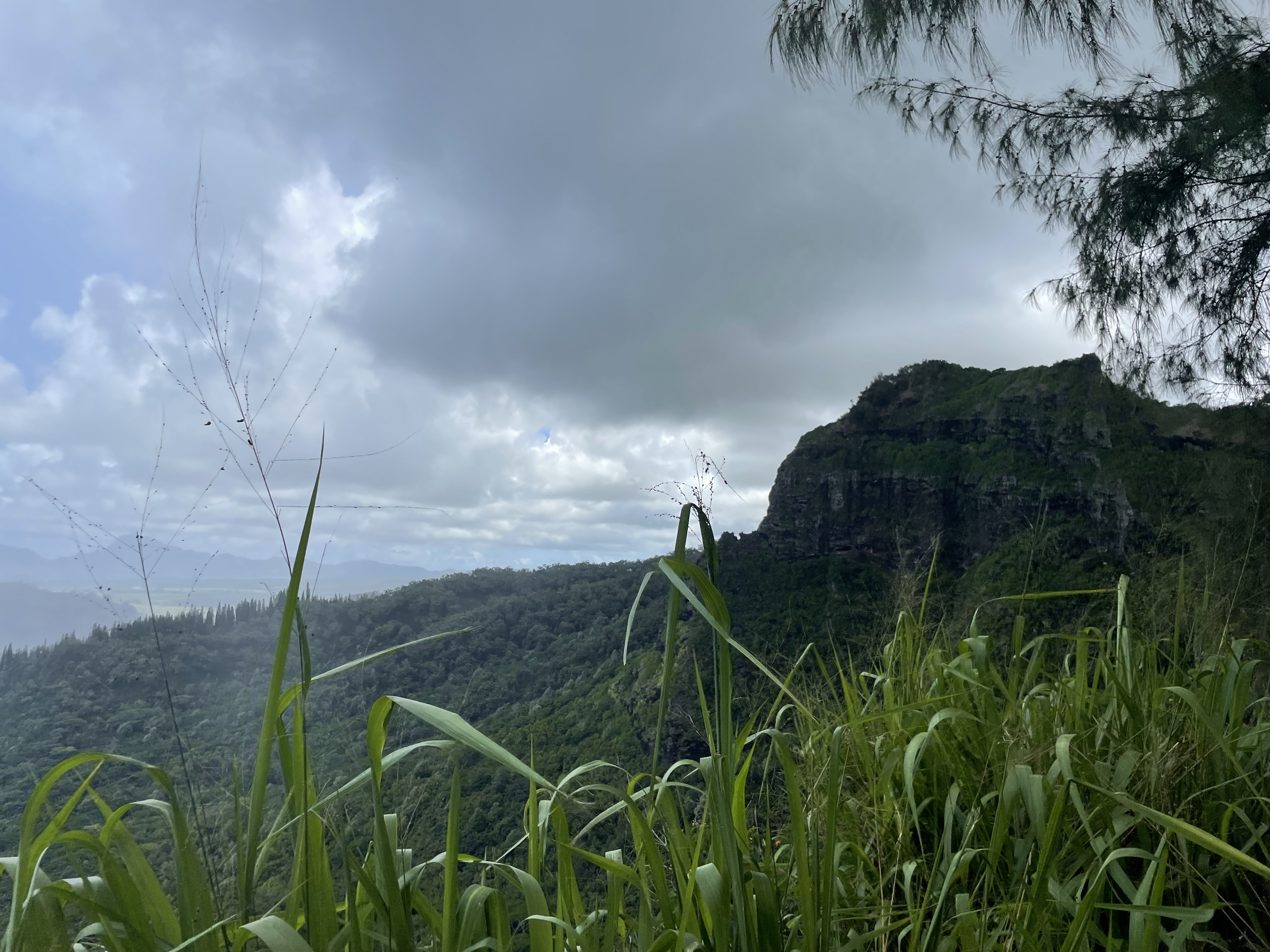
The Pihea Vista Trail is the highest-elevation hike on this list and offers views of a part of the Na Pali Coast — the Pihea Valley, just past Kalalau — that you simply cannot see from any other accessible vantage point. On a clear day, you also get sweeping views of the Alakai Swamp and Mt. Wai’ale’ale. It’s a remarkable perspective on the island’s wild interior.
The trail begins at the Pu’u O Kila Lookout at the end of the Kokee Road and descends steeply into the ridge. Here is our most important warning about this trail: the first section is a descent on red clay over rocks that become essentially frictionless when wet. Poles don’t help much on this particular section because the angle and the surface make it more of a stability problem than a traction problem. What you need here, more than anywhere else on the island, is sticky rubber on your soles. La Sportiva approach shoes or equivalent are not optional. In standard trail runners or hiking boots, this descent when wet is genuinely hazardous.
Once past the initial descent, the trail levels somewhat and the views begin to open. The first mile or so delivers the best scenery; you can turn around here for a shorter version if needed. The full trail eventually connects to the Alakai Swamp Trail — the highest trail on Kauai, crossing the wetlands that receive over 400 inches of rain annually, leading to a lookout over Hanalei Bay. The Alakai Swamp Trail is on our bucket list; we’ll update this post once we’ve done it.
Facilities: The Pu’u O Kila Lookout has restrooms and a small parking area. It’s the last stop at the top of Kokee Road and a natural end point for a full Waimea Canyon day.
Hike Comparison at a Glance
| Hike | Distance | Gain | Difficulty | Shore | Permit |
|---|---|---|---|---|---|
| Kalalau Trail (to beach) | 4 mi RT | 1,150 ft | Mod-Hard | North | Yes ($25) |
| Hanakapi’ai Falls (full) | 8 mi RT | 2,350 ft | Hard | North | Yes ($25) |
| Canyon Trail | 3 mi RT | 1,237 ft | Mod-Hard | West | $10/car |
| Awa’awapuhi | 6 mi RT | 1,900 ft | Hard | West | $10/car |
| Okolehao | 2.6–3.5 mi RT | 1,000+ ft | Hard | North | None |
| Kuilau Ridge | 3.5–5+ mi RT | 680–1,000 ft | Moderate -Easy | East | None |
| Mahaulepu Heritage | 3.8 mi RT | 400 ft | Easy | South | None |
| Sleeping Giant East | 3.2 mi RT | ~1,000 ft | Hard | East | None |
| Pihea Vista | 4.4 mi RT | 715 ft | Moderate | West | $10/car |
Frequently Asked Questions: Hiking in Kauai
What is the best hike in Kauai?
The Kalalau Trail to Hanakapi’ai Beach is our top pick (and pretty much everyone else’s, too!) — a 4-mile roundtrip hike along the Na Pali cliffs that delivers views unlike anything else accessible by foot in Hawaii. It’s moderately to strenuously difficult, requires a parking permit booked 30 days in advance, and is only accessible from the North Shore in summer when the road to Ke’e Beach is open.
Do I need a permit to hike the Kalalau Trail?
Yes. Parking at the Ke’e Beach trailhead requires a reservation through gohaena.com — $25/vehicle, available exactly 30 days in advance. These slots fill up fast; book the moment the window opens. Shuttle tickets ($40/person) are available as an alternative with less lead time. A separate camping permit is required for the full 11-mile trail to Kalalau Beach.
What shoes should I wear hiking in Kauai?
Approach shoes with sticky rubber outsoles are the best footwear for Kauai’s muddy, slippery trails. We consistently recommend La Sportiva approach shoes (TX4 for men, TX2 for women) — the same rubber technology used by rock climbers provides dramatically better grip on wet rock and clay than standard hiking boot rubber. Standard trail runners are inadequate for most of the trails on this list, particularly the Okolehao, Pihea, and Awa’awapuhi. See our Kauai Packing List for links and details.
Are the hikes in Kauai muddy?
Yes — almost all of them, to some degree, even in summer. The red volcanic clay on Kauai’s trails becomes extremely slippery when wet, which is most of the time on windward trails. The Okolehao and Sleeping Giant trails are particularly muddy. The Mahaulepu Heritage Trail on the South Shore is the notable exception — a coastal trail that stays relatively dry.
Is the Kalalau Trail dangerous?
The trail to Hanakapi’ai Beach is demanding but not technically dangerous for fit hikers with appropriate footwear. The terrain is rocky and slippery when wet, and the elevation gain is significant. The full 11-mile trail to Kalalau Beach involves more serious exposure and terrain and should only be attempted by experienced hikers. Never attempt to swim at Hanakapi’ai Beach — the shore break is extremely dangerous and there have been numerous fatalities.
What is the easiest hike in Kauai?
The Mahaulepu Heritage Trail on the South Shore is the best easy hike on the island — 3.8 miles roundtrip, relatively flat, no mud, and exceptional coastal scenery. The Kuilau Ridge Trail on the East Shore is on the easier side of moderate and suitable for families with older children.
When is the best time to hike in Kauai?
Early morning is always best — cooler temperatures, better light, and afternoon showers haven’t arrived yet. For the Kalalau Trail specifically, aim to start no later than 7am in summer. Summer (May–September) offers the best overall hiking conditions on Kauai, with drier weather on the windward North Shore and reliable access to the Ke’e Beach trailhead. See our when to visit guide for seasonal details.
Questions about any of these trails? Leave a comment below — we check and respond to every one. And for more on planning your Kauai trip, see our one-week itinerary — which includes a full day devoted to the Kalalau Trail — and our Kauai Packing List for the complete gear breakdown.


Leave a Reply